
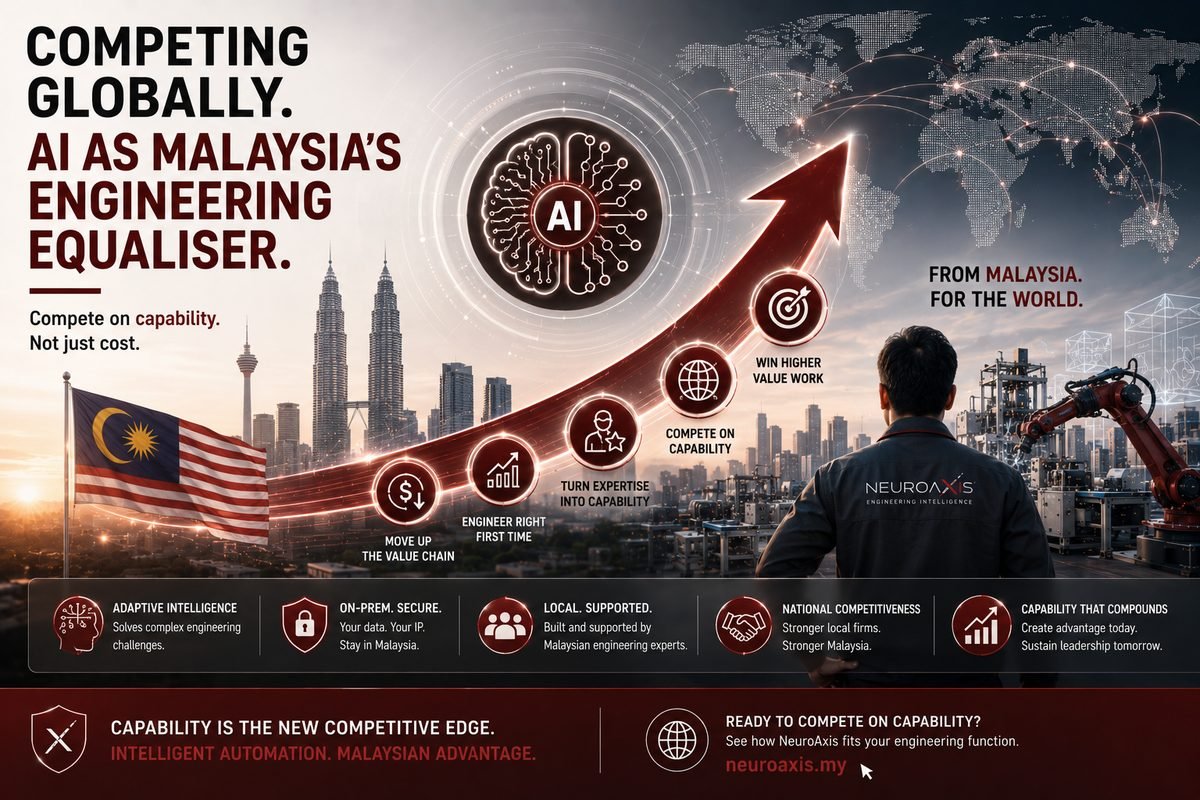
How does a Malaysian engineering firm move up the value chain instead of forever defending a position near the bottom of it? For a generation, the answer to global competitiveness here has been cost and reliability — do solid work, do it for less. That has built a real industry. But it is a position permanently under threat, and AI now offers something more durable: a chance to compete on engineering capability itself.
Cost advantages erode; capability compounds
A low-cost position is always on loan. There is always a next location prepared to do the work for less, and the moment one appears, the advantage migrates. Competing on cost is therefore a race that even the winner keeps having to re-run.
Capability behaves in the opposite way. Once a firm can engineer complex equipment right first time — defining it well, validating it rigorously, documenting it defensibly — it earns higher-value work that cannot easily be moved, because the customer is buying judgement and reliability, not just hours. That is the strategic case for investing in capability now: cost leadership is rented and revocable, while capability, once built, accrues to the firm that holds it and compounds over time.
Adaptive intelligence as leverage
The hard part has always been that engineering capability lives in scarce, senior people who take years to develop and can only be in one place at a time. NeuroAxis lets Malaysian firms apply adaptive intelligence to exactly that constraint — the hardest, most senior-dependent part of engineering, where requirements become validated, compliant designs.
That leverage — turning scarce expertise into repeatable, teachable capability — is precisely how a smaller player competes with a larger one. It is the same mechanism that makes world-class process maturity reachable for an SME rather than a privilege of the multinationals, and it does not require the firm to first hire a department it cannot afford.
Keeping the value, and the IP, at home
There is a national dimension to this that is easy to miss. Because deployment is on-prem and the platform is locally built and supported, both the capability and the data stay in Malaysia. The competitive gain accrues to local firms and to the national supply base — not to an overseas cloud vendor that captures the value and the learning.
That alignment with national industrial priorities, visible in the direction set by MITI, is not incidental. It is how a country raises the capability of its whole industrial base rather than renting capability from abroad one subscription at a time.
From cost centre to capability partner
The strategic destination is a change in how a Malaysian firm is seen by its customers. A supplier valued only for low cost is, by definition, replaceable on price. A supplier that can take an ambiguous brief and return a well-engineered, fully-traceable, compliant solution becomes a partner the customer is reluctant to lose. That repositioning — from cost centre to capability partner — is the durable prize, and it is available precisely because the hardest, most senior-dependent work is the part adaptive intelligence helps most.
Ready to compete on capability? See how NeuroAxis fits your engineering function and where it would deliver first.