
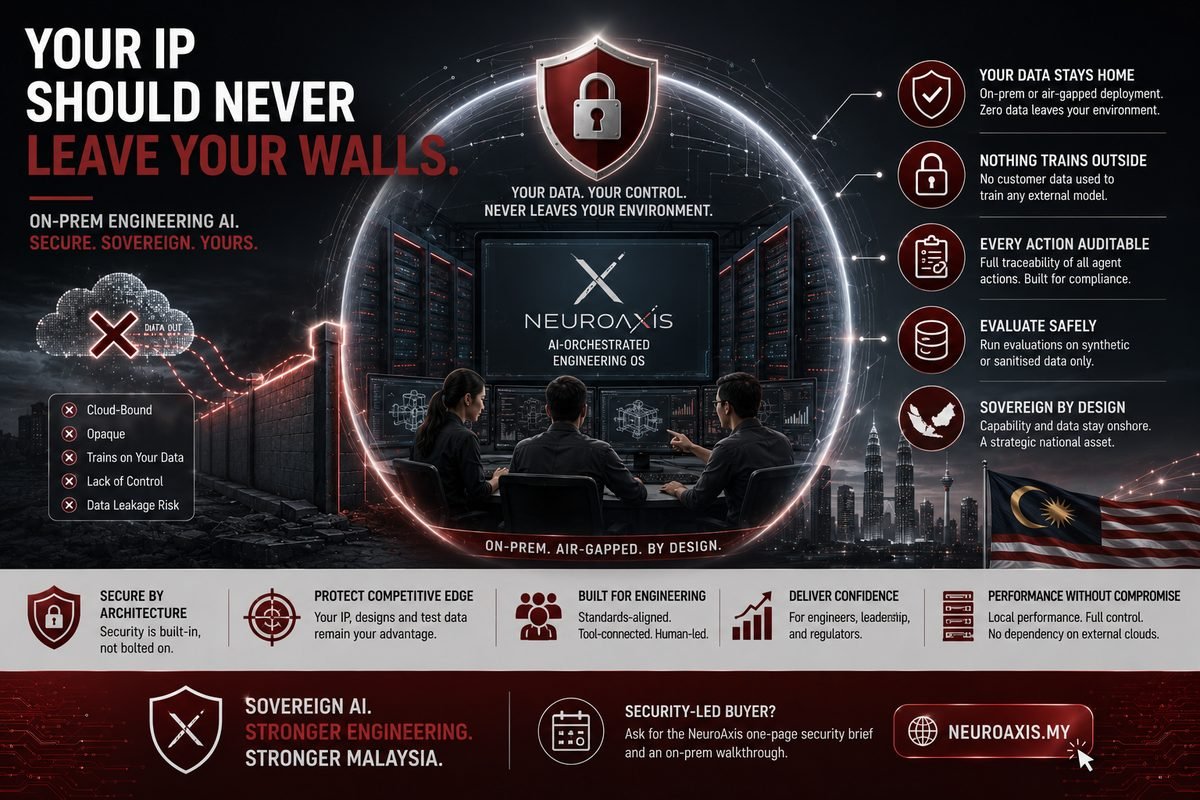
“Is our IP safe?” is the first question every engineering leader asks of an AI tool — and it should be. When your requirements, designs and test data are the very things that distinguish you from a competitor, a reassuring shrug and “don’t worry, it’s in the cloud” is not an acceptable answer. It is the answer that should end the conversation.
This is not paranoia. For a capital-equipment firm, the accumulated engineering knowledge is the business. Treating it casually is treating the business casually.
The real risk of cloud-bound engineering AI
Many AI tools are, by design, cloud-bound, opaque, and trained on what users feed them. Each of those traits is convenient. Together, for engineering organisations and government bodies alike, they put the most valuable and most sensitive data in the least controllable place — on infrastructure you do not own, processed in ways you cannot fully inspect, potentially improving a model your competitors also use.
The exposure is not hypothetical, and it is not reversible. Once proprietary design data has left your environment, you cannot call it back. No after-the-fact assurance restores control of information that has already been copied, logged or learned from somewhere else.
Sovereignty by architecture, not by patch
NeuroAxis takes the opposite default. Deployment is on-prem or air-gapped. Your data never leaves your environment. Nothing you process is used to train any external model. Every agent action is logged and auditable, and evaluation can run entirely on synthetic or sanitised data, so you can prove the value before any real IP is involved at all.
The important word is default. Sovereignty here is not a premium feature added later to placate a nervous customer; it is the architecture from day one. That is the same boundary that lets an engineering operating system be trusted at all: bounded, logged, and firmly under your control rather than someone else’s.
Why this matters for Malaysia
There is a national dimension beyond any single firm’s risk register. For a country pursuing an industrial and AI agenda, sovereign AI keeps both capability and data onshore — a strategic asset, not merely a security checkbox to be ticked.
It is, in the end, how a nation builds engineering capability inside its own walls rather than renting it from abroad. That principle sits at the centre of the industrial-transformation goals supported by bodies such as MDEC, and it is why on-prem is not a constraint to be tolerated but a feature to be insisted upon.
Questions worth asking any AI vendor
Whatever a firm ultimately adopts, a few questions separate genuine sovereignty from reassuring language. Where, physically, does our data go? Is anything we submit used to train a model others can access? Can we run the system air-gapped, and can we evaluate it on synthetic data first? Is every action logged in a form an auditor would accept? A vendor confident in its architecture answers these plainly. A vendor that deflects to “enterprise-grade security” without specifics is answering a different question than the one being asked.
Security-led buyer? Ask for the NeuroAxis one-page security brief and an on-prem walkthrough.