
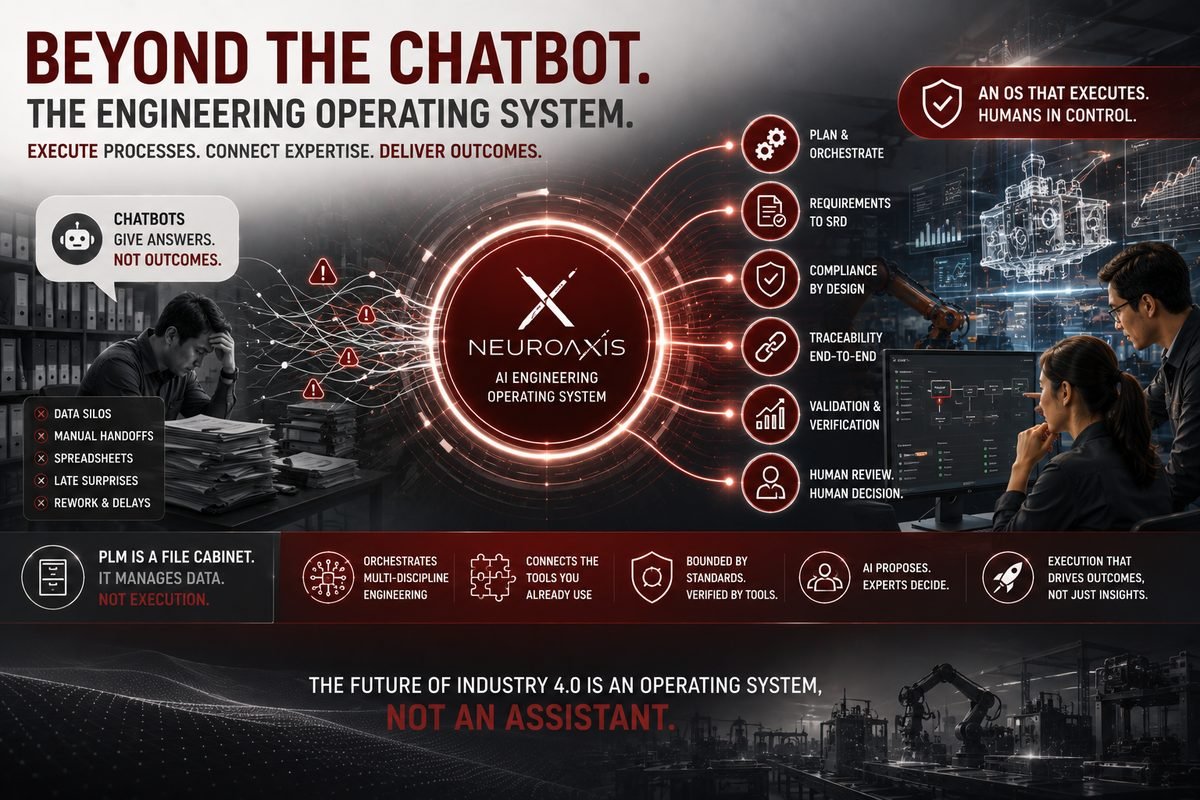
What should “AI for engineering” actually mean? Right now, most tools sold under that banner are chatbots wearing a hard hat. They are fluent, fast, and confident. But engineering does not run on confident — it runs on verifiable: bounded by standards, checked by tools, and signed off by a named human who is accountable for the result.
A plausible answer that cannot be traced, justified or audited is not an asset in this domain. It is a liability with good manners. The interesting question is what a genuinely useful system looks like instead.
Data management is not execution
Start with what the incumbent tools do. Traditional Product Lifecycle Management (PLM) systems manage data: they store the what — the parts, the revisions, the documents. That is valuable, but it is passive. They do not execute the how.
The actual coordination of engineering work — the handoffs between disciplines, the mapping of designs to compliance requirements, the maintenance of traceability as things change — is left to manual effort, email threads and static spreadsheets. A repository, however well organised, never moves the work forward by itself. It is a filing cabinet, and a filing cabinet does not do your job.
An execution layer over your expert tools
An engineering operating system is a different category of thing. NeuroAxis is an orchestration layer that executes processes across mechanical, electrical and software disciplines, coordinating the expert tools a team already owns rather than replacing them. It is the difference between a filing cabinet and an operating system: one holds information, the other actually gets work done.
That distinction is not semantic. It is what allows the system to compress the front end of a programme rather than merely describe its current state — to act on the process, not just record it. The expert tools stay; what changes is that the work between them is now coordinated and executed rather than carried by hand.
Adaptive intelligence, kept honest
The reason this can be trusted is that the intelligence is deliberately fenced. This is what adaptive intelligence should mean in practice: a system that learns and accelerates, but stays bounded by recognised standards — the kind of systems-engineering discipline codified by INCOSE — and by human gates at every consequential decision.
Kept honest in this way, the technology earns a permanent place in the workflow rather than a novelty slot in a pilot. And because it runs inside your own walls, the capability it builds stays yours. That — verifiable, bounded, sovereign — is the version of Industry 4.0 worth building.
The Industry 4.0 that lasts
Plenty of “AI for engineering” tools will be quietly retired once the demos stop impressing, because a system nobody can stand behind never becomes part of how real work is done. The version that lasts is the one built the other way around: bounded by standards, gated by humans, auditable end to end, and sovereign to the organisation that runs it. That is not the most dazzling demo in the room, but it is the one an engineering team will still be using in five years — because it earns trust every day rather than spending it.
See what an engineering operating system actually does. Explore the NeuroAxis modules.