
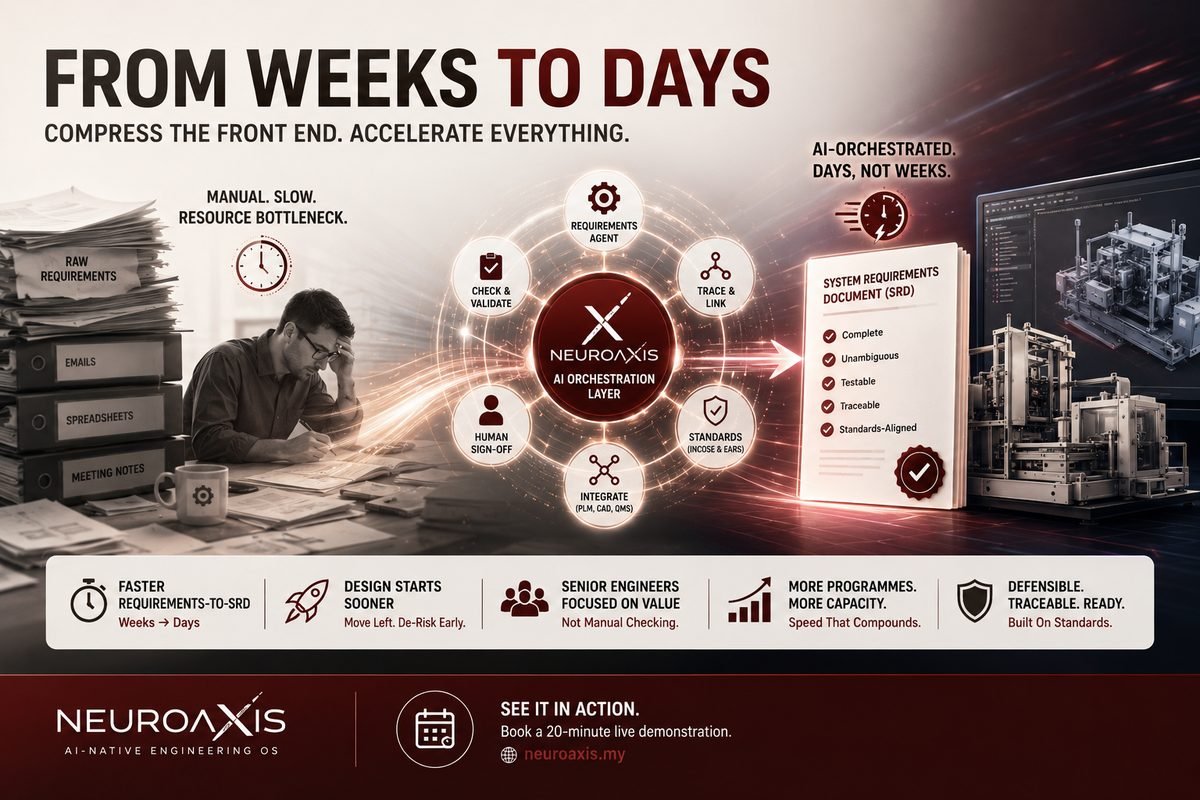
Where does an equipment programme actually lose its time? When people set out to speed up engineering, they reach for the obvious levers: faster CAD, quicker prototyping, more capable test rigs. Those help. But the longest, least visible delay usually sits right at the front of the programme — in the unglamorous work of turning a customer’s raw, often contradictory requirements into a clear, testable specification the rest of the team can build against.
That stage rarely appears on a status dashboard as a bottleneck, because it looks like “thinking” rather than “work.” Yet it routinely takes weeks, and nothing downstream can safely begin until it is done.
Why the front end is the real bottleneck
Requirements definition is bottlenecked on a handful of senior engineers. They are the only people who can reliably judge whether a specification is complete, consistent and testable — and so everyone waits on them. Worse, those scarce people spend a large share of their hours on conformance checking and traceability: essential, repetitive work that does not scale by hiring, because the expertise behind it is rare and slow to grow.
The effect is a queue. Programmes line up behind the same few experts, and the organisation’s throughput is capped not by its workshop or its CAD seats, but by the availability of senior judgement at the front door. Until that handoff clears, design cannot start. Compress it, and the entire schedule shifts left.
What an engineering operating system changes
NeuroAxis acts as an execution layer, not a data repository. It coordinates domain-aware agents across mechanical, electrical and software disciplines to draft, check and trace requirements against recognised systems-engineering practice such as INCOSE guidance — then routes each decision to a human for sign-off. It connects to the CAD, PLM and QMS tools a team already runs, so nothing has to be ripped out and replaced to get value.
The practical effect is twofold. First, a large reduction in time-to-SRD, because the mechanical parts of the work happen in parallel and in minutes rather than in sequence and in days. Second, a large reduction in manual traceability effort, because the links between requirements, tests and design elements are maintained as the work proceeds rather than reconstructed at the end. Because the same checking discipline also removes costly defects at intake, the speed does not come at the expense of quality — it comes from removing rework.
Speed that compounds
A faster front end does not simply save a few weeks once. It frees senior engineers to start the next programme sooner, which raises the number of programmes a team can carry at all. In other words, the benefit is not a one-time discount on a single schedule; it is a permanent lift in capacity.
For organisations facing more demand than they can build — an increasingly common position in capital equipment — that compounding is the real prize. It is also what turns a faster cycle into genuine time-to-market advantage, where the firm that can define and validate fastest wins the order.
What it looks like in practice
Concretely, a requirements package that once sat with a senior engineer for two to three weeks enters NeuroAxis and is returned, the same week, as a structured draft: ambiguous lines flagged, missing safety, power and thermal criteria surfaced, and a traceability skeleton already in place. The engineer is no longer authoring from a blank page and chasing references — they are reviewing, correcting and approving grounded proposals. The hours saved are real, but the more important shift is what those hours are spent on: judgement instead of transcription.
The honest way to judge any of this is on your own data, not on a slide. Book a 20-minute live demonstration of the NeuroAxis MVP and watch requirements-to-SRD compressed on a package of your choosing.