
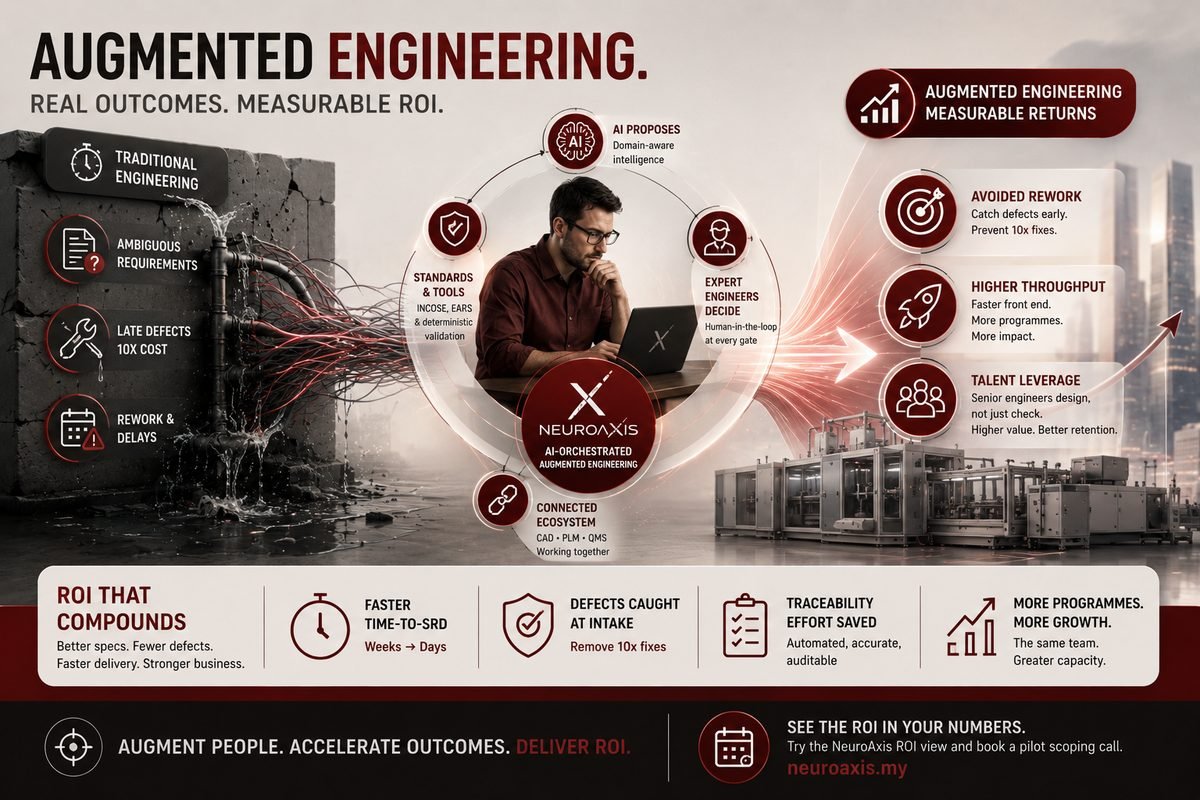
What does augmented engineering actually return? Every engineering leader has now sat through an AI demo. Far fewer have seen an AI tool survive contact with a real specification — the messy, contradictory, half-finished kind that arrives from an actual customer. The useful conversation is not about novelty. It is about return: throughput, avoided rework, and where your scarcest people spend their hours.
That reframing matters, because it changes the question from “is this impressive?” to “does this move a number I am accountable for?” The honest answer for augmented engineering is yes — and the value shows up in three specific, measurable places.
Three places the value shows up
The return is not abstract. It lands in three concrete buckets that any engineering leader already tracks.
- Avoided rework. Catching requirement defects at intake removes the roughly tenfold fixes that quietly consume budgets and slip dates. This is the largest and most under-measured saving, because the avoided cost never appears as a line item — the disaster simply does not happen.
- Throughput. A faster front end lets the same team carry more programmes, without adding the senior headcount that the market cannot readily supply. More programmes from the same payroll is, directly, more revenue capacity.
- Talent leverage. Senior engineers move from checking to designing — work that is both higher value to the business and far more satisfying, which makes it a quiet but real retention lever.
Why “augmented,” not “automated”
NeuroAxis is deliberately built as augmented intelligence: the AI proposes, expert engineers decide, at every gate. This is not a cautious hedge. It is the source of the trust on which the return depends. Outputs are bounded by recognised standards, such as those championed by INCOSE, and verified by deterministic tools, so the human is reviewing grounded proposals rather than plausible-sounding guesses.
The distinction is what separates durable value from a one-off demo. An automated black box impresses once and is quietly distrusted thereafter, because nobody can stand behind an answer they cannot inspect. An augmenting system earns a permanent place in the workflow precisely because every decision it supports is visible, explainable and owned by a named engineer. To the team, that feels less like surveillance and more like getting their week back.
Make the number your own
The most credible way to size the return is to refuse to take anyone’s word for it — including ours. A scoped pilot on your own requirements produces real deltas: time-to-SRD before and after, defects caught at intake, traceability effort saved. Those numbers, drawn from your own programmes, will always be more persuasive to your board than a vendor’s illustrative averages.
This is also the safest way to adopt. A bounded pilot limits exposure, builds internal evidence, and lets the engineering team form its own judgement before anything is rolled out widely. The return is real; the point is to prove it in your own context.
Why the return holds beyond the first programme
A common worry is that AI gains fade once the novelty wears off. The opposite tends to happen here, because the value is structural rather than motivational. The checking capacity does not get tired, the traceability does not lapse under deadline, and the encoded standards do not forget themselves between projects. Each programme starts from a cleaner, faster baseline than the last, and the senior time freed early compounds across the portfolio. The return is not a one-off efficiency spike; it is a permanent change in how much engineering the same team can carry.
Want the return in your own numbers? Try the NeuroAxis ROI view and book a pilot scoping call.