
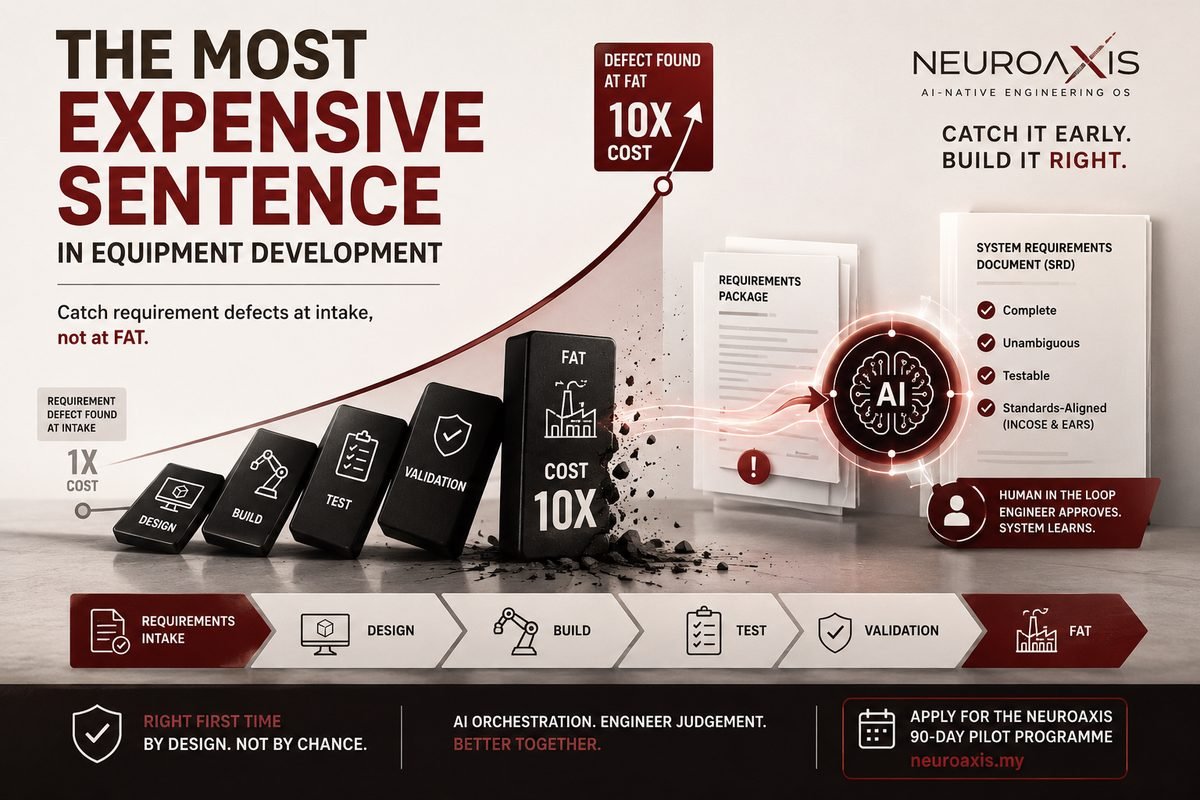
What is the most expensive mistake in capital-equipment development? It is rarely a tooling error, a fabrication slip, or a supplier delay. More often, it is a single ambiguous sentence that nobody caught at the very start — a sentence that looked harmless in a requirements document and quietly set fire to the budget six months later.
Consider a requirement that reads, “The system shall be fast.” Fast how? Measured against what baseline? Verified by which test, under which load? That one line survives the review because everybody assumes someone else has pinned it down. It gets designed around, gets built, and finally fails in validation — where the fix costs an order of magnitude more and slips the launch date. In equipment engineering, the most expensive mistakes do not start in design or on the floor. They start in a sentence.
Why a late defect costs roughly ten times more
The cost-of-change curve is one of the most reliable findings in systems engineering: the later a defect is found, the more accumulated design, procurement and build work must be unwound to correct it. A requirement defect caught at intake is a five-minute edit to a document. The same defect caught at validation or Factory Acceptance Test (FAT) is a different animal entirely.
By then, the ambiguous line has been interpreted by a designer, embodied in a sub-assembly, priced into a bill of materials, and qualified against the wrong target. Correcting it can mean re-spinning hardware, re-running qualification tests, renegotiating with a supplier, and — worst of all — explaining a slipped milestone to a customer who has their own downstream commitments. The cash cost is large; the relationship cost can be larger.
A capacity problem, not a competence problem
It is tempting to treat late defects as a discipline issue — if only the team reviewed more carefully. But the engineers are not careless. The honest diagnosis is that no team has the capacity to check every requirement, for ambiguity, completeness and testability, across mechanical, electrical, software and controls, every single time, under deadline pressure.
A capital-equipment programme can carry hundreds of requirements, each of which should be examined from several angles. Doing that exhaustively by hand, on every revision, would consume the very senior engineers whose time is scarcest. So in practice, sampling happens, judgement calls are made, and a small number of weak requirements slip through. The defect is not a failure of skill. It is a failure of capacity.
Closing the capacity gap with orchestration
This is precisely the gap NeuroAxis is built to close. It is an AI-native engineering operating system that reads a requirements package at intake and flags what is ambiguous, incomplete or untestable — bounded by recognised practice such as INCOSE systems-engineering principles and the EARS notation, not by a chatbot’s guesswork. Crucially, every finding is a proposal, not a verdict: a human engineer accepts, rejects or refines it, so expertise stays in command.
The result is a defensible System Requirements Document produced in days rather than weeks, with the costly defects removed before a single design decision is built on top of them. That same discipline at the front end is also what lets a team compress the whole programme and start design sooner, on firmer ground.
Making “right first time” a property of the system
“Right first time” is language every engineering leader already uses. The difficulty has always been turning it from a poster on the wall into something the organisation can actually rely on. The shift NeuroAxis enables is to make it a property of the system rather than a slogan — by giving teams the checking capacity they never had, while keeping expert judgement firmly in control.
When the weak requirements are caught at their source, every downstream stage inherits a cleaner foundation, and the saving compounds: fewer late changes, fewer re-qualifications, fewer awkward calls to the customer. The return on that discipline shows up directly in throughput and avoided rework — which is where the real money is.
Curious where your own late defects begin? Our structured 90-day pilot takes one real or sanitised requirements package from intake to an approved SRD, and measures the difference on your own data — not on a vendor’s illustrative figures.