
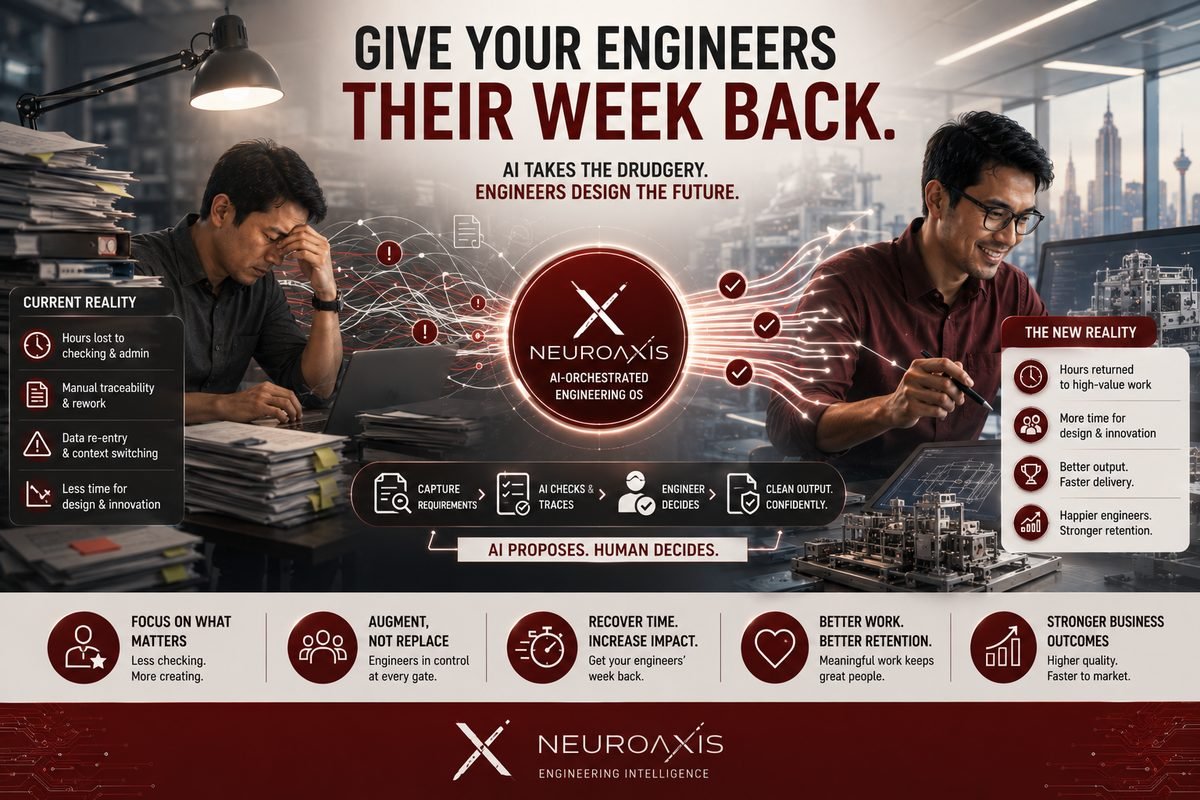
Where does an experienced engineer’s week actually go? Ask honestly, and the answer is remarkably consistent: checking requirements, chasing traceability, re-typing data between tools that do not talk to each other, and assembling documentation for a gate review. All of it essential — and almost none of it the work they trained for, or the work where their judgement creates the most value.
This is the quiet reality behind the anxious headline question about AI in engineering. The fear is replacement. The opportunity, handled well, is the opposite.
The hidden tax on your best people
When senior engineers spend their scarcest hours on conformance checking and document wrangling, two things suffer at the same time. The work that genuinely needs human judgement — the design decisions, the trade-off calls, the risk assessments — queues up behind administrative effort. And the people most worth retaining spend their days on the least satisfying part of the job.
It is a tax that never appears on a budget line, which is exactly why it goes unaddressed. But it is real, and it is expensive: paid first in delayed high-value work, and second in the slow attrition of senior people who quietly conclude that their expertise is being wasted.
Augmentation, with the human in command
NeuroAxis is built to flip that ratio. It takes the repetitive checking and traceability off the desk, proposes a clean result, and hands the decision to the engineer — AI proposes, the human decides. Nobody is removed from the loop; the load is rebalanced away from administration and back toward judgement and design.
That principle is not a marketing softener. It is the same logic of augmented intelligence that makes the technology trustworthy in the first place, applied to the texture of the working day. It is also the practical face of an engineering operating system: not a clever assistant that answers questions, but an execution layer that quietly carries the repetitive load so people can do the work only people can do.
Better output, better retention
Teams feel this in two ways at once. There is recovered design time — hours returned to the work that actually advances the programme. And there is lower frustration, because the most capable people are no longer spending their days on tasks that feel beneath their training.
For an SEMI world already short of senior engineers, that second effect is not a soft benefit. Giving your best people their week back is a productivity gain and a retention strategy in the same move: the engineers who might otherwise leave for less tedious work stay, because the tedious work is gone.
What changes on Monday morning
The shift is concrete, not aspirational. The engineer who used to open the week with a stack of requirements to comb through instead opens a set of reviewed proposals, each with its reasoning and its open questions already surfaced. Their attention goes to the decisions that genuinely need a human — the trade-offs, the risks, the design intent — while the mechanical checking has already been done and laid out for sign-off. The job becomes more like engineering and less like administration, which is exactly the job those people wanted in the first place.
Imagine your best engineers designing instead of checking. Book a 20-minute MVP demonstration and see it on a real workflow.